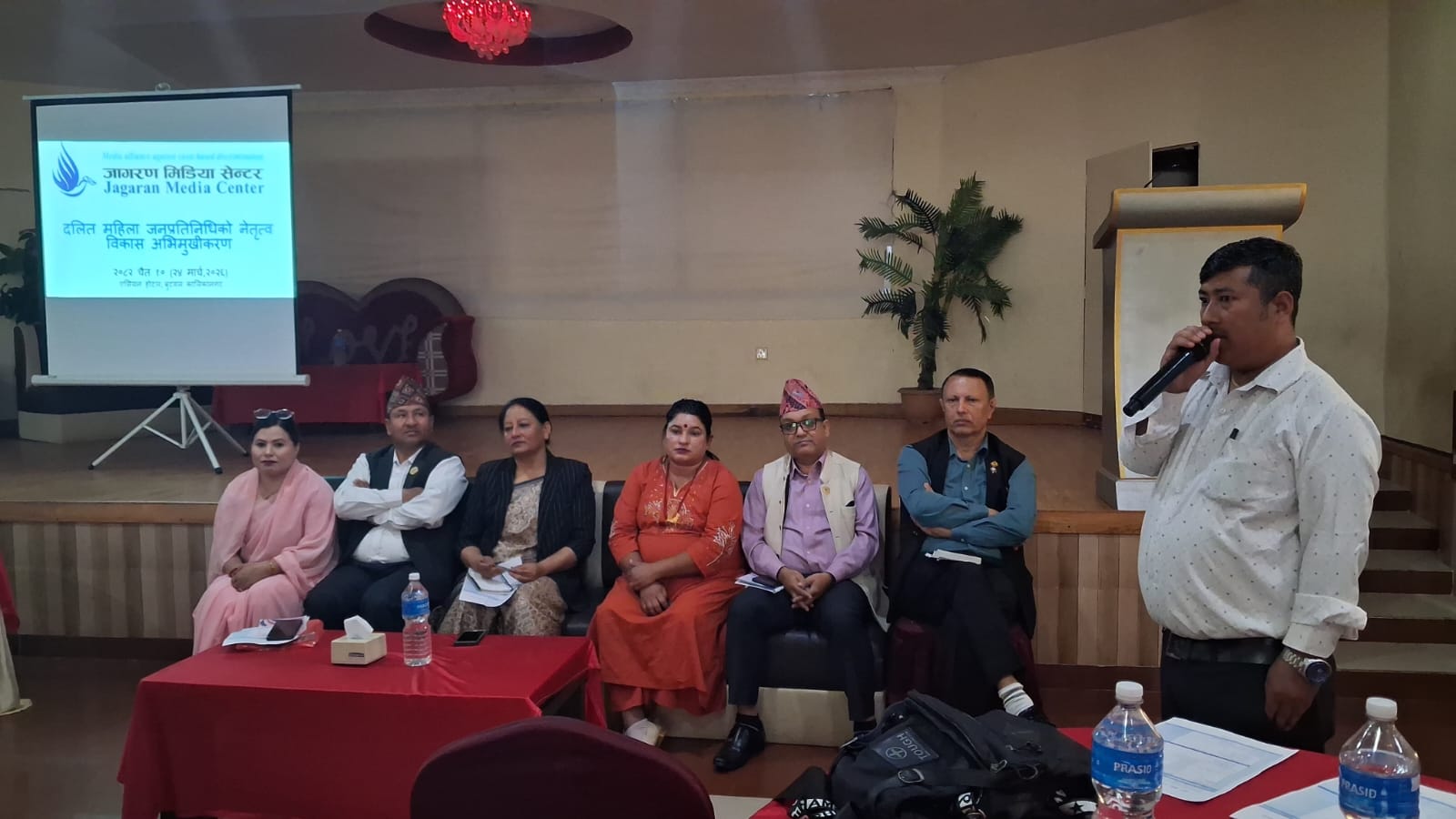
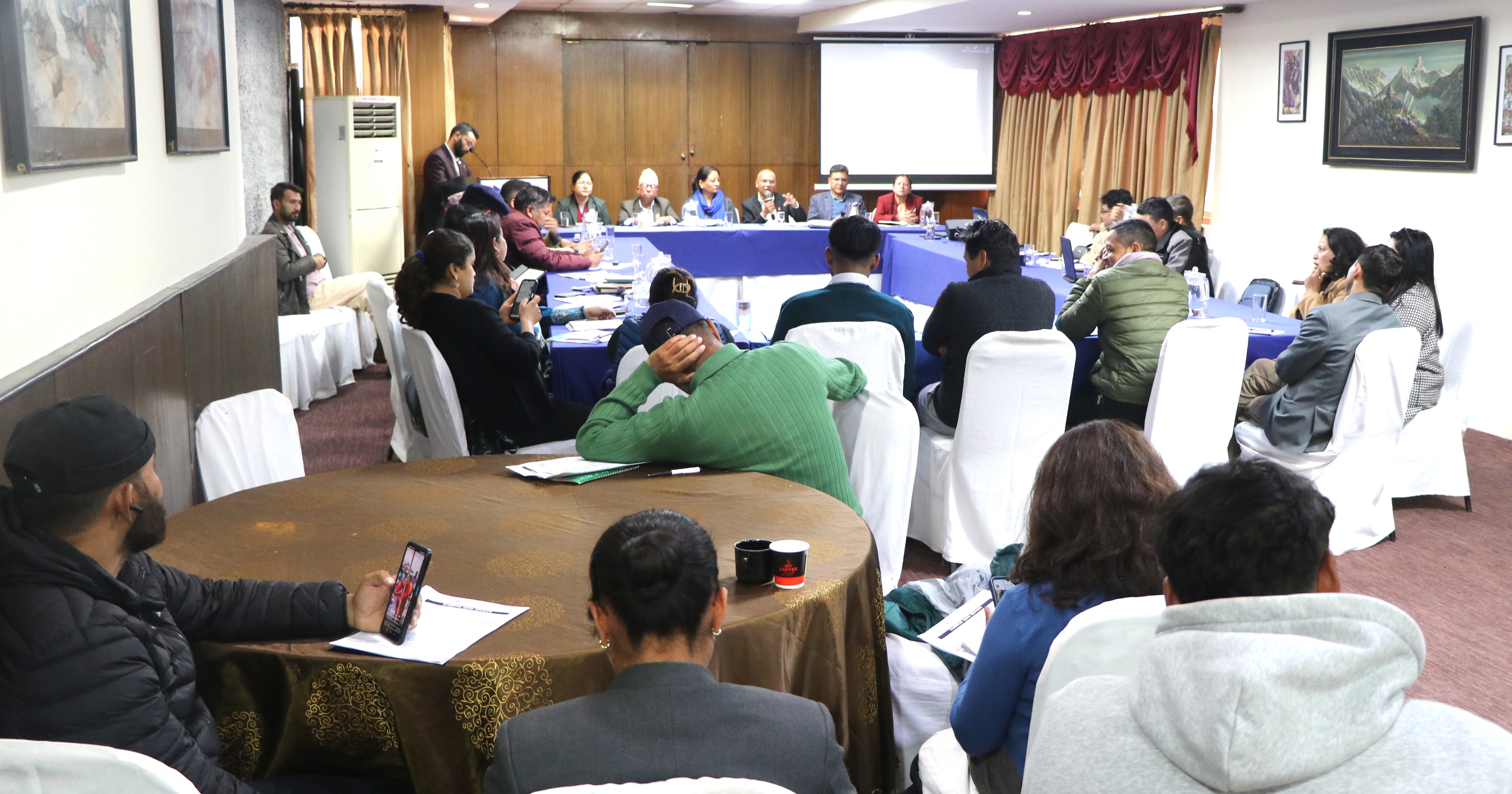
Kathmandu, Feb 20 – Targeting the upcoming House of Representatives Election–2082 scheduled for Falgun 21, Jagaran Media Center conducted an interaction program focusing on the commitments made by various political parties in their election manifestos regarding Dalits, women, and marginalized communities.
Speakers at the program pointed out that while inclusive commitments have been repeatedly mentioned in past elections, implementation has remained weak. They emphasized that although Article 24 (Right against Untouchability and Discrimination) and Article 40 (Rights of Dalits) of the Constitution of Nepal guarantee dignity, equality, and social justice, full implementation has yet to be realized in practice.
According to the 2021 national census, Dalits constitute 13.4 percent of Nepal’s population. However, the community continues to face challenges such as landlessness, poverty, caste-based discrimination, educational backwardness, and low representation in state decision-making bodies.
Women, too, continue to face gender-based violence, economic inequality, and limited access to decision-making processes.
Constitutional and administrative law expert Kashiraj Dahal presented a study of the manifestos of 10 political parties, noting that while commitments are repeated, they lack clear implementation plans, budget allocations, timelines, and monitoring mechanisms.
 According to him, the Nepali Congress has pledged scholarships up to higher education, safe housing, free health insurance, concessional loans, and amendments to laws against untouchability. The Communist Party of Nepal (UML) has proposed programs for managing landless Dalits, promoting entrepreneurship, and ending caste-based discrimination. The Communist Party of Nepal (Maoist Centre) has mentioned an integrated Dalit Development Act, the formation of a Dalit Development Authority, and concessional loan programs.
Similarly, the Rastriya Swatantra Party has pledged a formal apology for historical discrimination. It has proposed structural reforms, while the Janata Samajbadi Party, Nepal, has proposed reserved electoral constituencies and strengthened proportional representation.
 However, Dahal criticized most manifestos for failing to provide concrete details on action plans, budget allocation, timeframes, and monitoring systems. He concluded that effective implementation requires guaranteed access to quality and free technical and higher education, time-bound land and housing plans for landless and homeless Dalits, proportional representation in all state bodies, strict enforcement of laws against untouchability and discrimination, and targeted budgets with public monitoring mechanisms.
During the discussion, Prem Bishwakarma, a central member of the Nepali Congress, said that party manifestos often remain limited to “lists of commitments,” with weak political will in implementation. He added that internal party arguments frequently cite the lack of a majority government as a barrier to advancing policy programs.
 Dr. Netra Timilsena, a member of the UML manifesto drafting committee, described caste discrimination as a structural problem requiring progressive movements for its eradication. Nepali Communist Party leader Dr. Beduram Bhusal stated that since laws have already been formulated, the focus must now shift toward strengthening implementation.
Representatives from the National Women's Commission and the National Dalit Commission informed that monitoring of issues related to Dalit women and marginalized communities would be conducted during the election campaign period.
Dr. Gopal Shivakoti, Chairperson of Election Observation Nepal, remarked that the absence of concrete policy frameworks, budgets, and timelines has led to the repetitive nature of manifestos.
 Former Constituent Assembly member and Chairperson of Jagaran Media Center, Kamala Bishwakarma, noted that while most parties repeatedly promise to “ensure representation” and “end untouchability,” data from past parliaments and governments show extremely low representation of Dalits, revealing a significant gap between commitments and implementation.
J.B. Bishwakarma, Chairperson of the Dalit NGO Federation, argued that even a decade after the promulgation of the Constitution, Dalit rights remain inadequately addressed in practice. He questioned why political parties have not demonstrated sufficient political will to implement constitutional provisions related to Dalit rights.
 Dalit rights activist Pampha Pariyar emphasized that issues of Dalit representation and ending untouchability are repeated in every election, yet remain largely unimplemented. She urged political parties to translate manifesto commitments into concrete action.
Speakers, including Ganesh Dhami, President of Youth Advocacy Forum; Parshu Chaudhary of the Blue Diamond Society; Bishnu Pokharel of Juri Nepal; journalist Keshav Bhul; and advocate Chija Bishwakarma, stressed that democracy should not be limited to electoral procedures alone, but must ensure social justice, equality, and the right to live with dignity.
Participants concluded that drafting and effectively implementing an “Integrated Dalit Law” could help address many of the persistent challenges faced by the Dalit community.
The program was moderated by Dinesh Kumar Pariyar, Vice President of Jagaran Media Center, while Executive Director Raj B.K. clarified the rationale and objectives of the event.